Service Dog Tasks and the Public Access Test, Explained
This page explains the law in general terms. It is not legal advice. For a specific situation, contact the agency listed on this site or an attorney.
Two ideas come up again and again when people start training a service dog: the tasks the dog performs, and the public access test. They are related, but they do different jobs. Tasks are what make a dog a service animal under federal law. The public access test is a training benchmark, not a legal requirement.
This guide shows you how to identify and train real tasks, how to use a public access test to check your progress, and how Wyoming law fits in. It is a plain-English explainer, not legal advice.
What you need before you start
- A written description of how your disability affects daily life. Tasks should answer specific problems on that list.
- A dog with a stable temperament and good health. Ask your own veterinarian whether your dog is a good fit for the work.
- A flat buckle collar or a well-fitted harness, and a standard leash. Reward-based training does not need anything harsher.
- Small, soft treats your dog loves, plus a toy or other reward for dogs that are not food motivated.
- A notebook or phone app for training logs.
- Access to quiet practice spaces first, then busier ones.
- Time. Task training and public access skills build slowly, in short sessions.
What counts as a task under the ADA
ADA.gov defines a service animal as a dog that is individually trained to do work or perform tasks for an individual with a disability. The key word is trained. The dog does something, on purpose, that helps with the disability.
A useful test is this: does the behavior directly relate to the person's disability, and did the dog learn it through training? If both answers are yes, it is very likely a task. If the answer is no, it probably is not.
Examples of tasks by disability
ADA.gov's service animal guidance gives examples along these lines. The list below is illustrative, not complete, and every handler's needs differ.
| Type of disability | Example tasks |
|---|---|
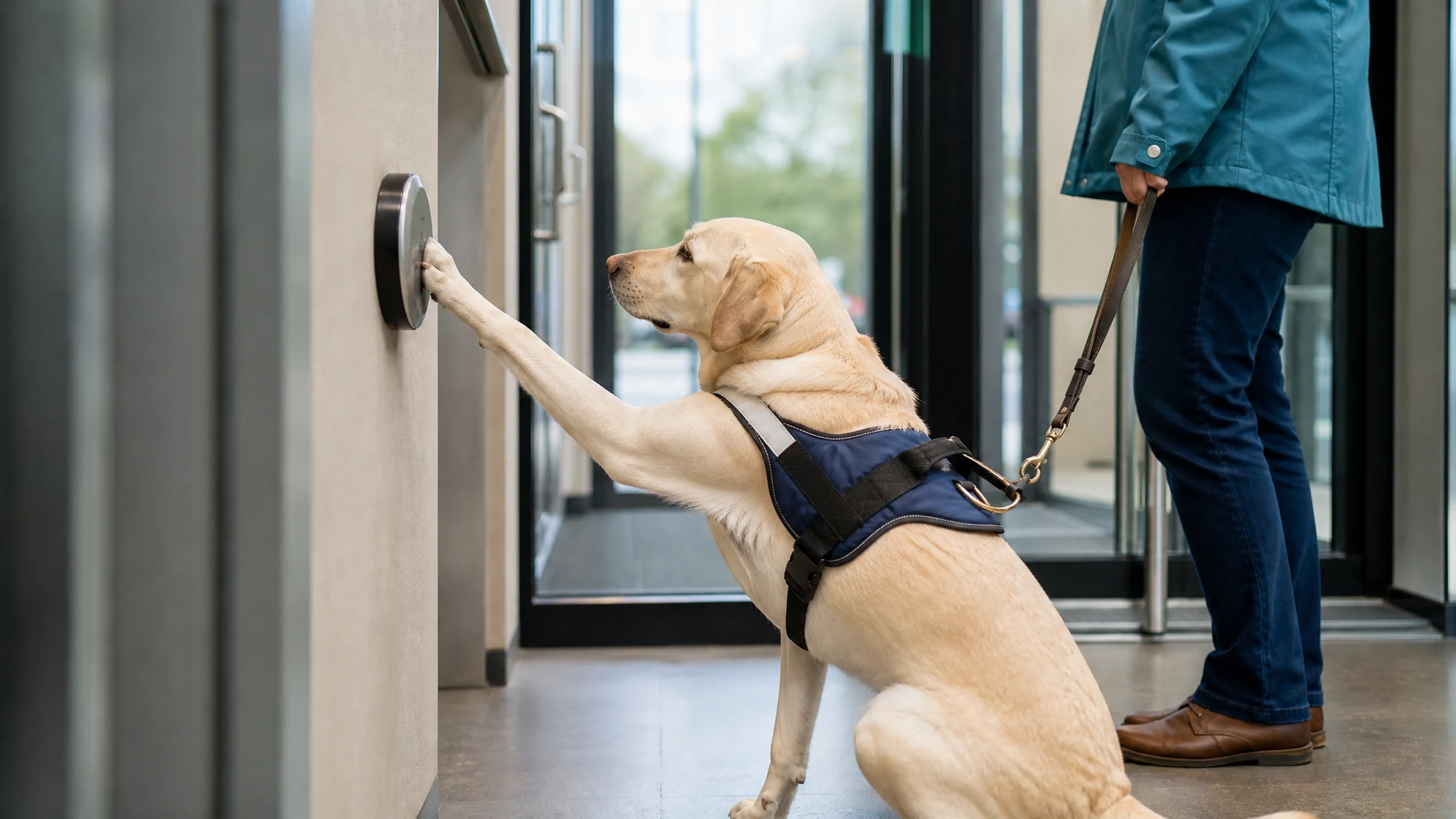
| Mobility | Retrieving dropped items, opening or closing doors, pulling a manual wheelchair, bracing for balance support |
| Vision | Guiding around obstacles, stopping at curbs and stairs |
| Hearing | Alerting to a doorbell, alarm or a person calling the handler's name |
| Seizure or medical conditions | Responding to a seizure by getting help or staying with the person, alerting to a medical change the dog has been trained to signal |
| Psychiatric, such as PTSD | Interrupting repetitive behaviors, turning on lights and checking a room, applying deep pressure on cue, creating space in a crowd |
| Medication or routine support | Prompting the handler to take medication at a set time |
If you are wondering what tasks a service dog can do, the honest answer is that the list is open ended. Any trained action that directly helps with a disability can count. The ADA does not publish a closed menu.
Why comfort alone is not a task
A dog that calms you by being near you, or that makes you feel safe by simply being present, is doing something valuable. Under the ADA, though, that is not work or a task. Emotional support, therapy and comfort animals are not service animals under the ADA.
Compare two situations:
- A dog that sits beside someone who feels anxious. This is comfort by presence.
- A dog trained to notice early signs of a panic episode and then perform a specific action, such as a deep pressure cue or interrupting a behavior. This is a task.
The difference is training and a direct link to the disability. Wyoming law also recognizes a broader category called an assistance animal, which includes animals that provide help beyond ADA service animals, including emotional support animals. Under Wyo. Stat. 35-13-201(c), assistance animal rules apply to residential leasing and renting. The federal Fair Housing Act also applies to housing. The state's public access protections track the ADA definition of a service animal, so the task distinction still matters when you go into stores, restaurants and other public places.
Step by step: how to train and document a task
Step 1: Match each task to a need
Write down three to five specific barriers your disability creates. For each one, ask what a dog could do that would reduce the barrier. A person with a mobility disability might list "cannot pick up dropped keys." A person with PTSD might list "cannot tell if the room is clear when I enter at night." Each barrier becomes a candidate task.
Step 2: Break the task into small pieces
Trainers call this shaping or chaining. To teach a dog to retrieve a dropped item, you might first reward looking at the object, then touching it with the nose, then mouthing it, then holding it, then carrying it, then placing it in your hand. Reward each small step before asking for more.
Step 3: Add a cue or a trigger
A task needs a clear starting signal. Some are verbal or hand cues you give. Others are triggers the dog responds to on its own, such as a sound, a scent or a repeated movement. Teach the cue in a quiet room before you ask for it anywhere else.
Step 4: Practice in new places
Dogs often fail to generalize. A dog that retrieves perfectly in the kitchen may be lost in a parking lot. Move the practice to different rooms, then your yard, then quiet public places. Lower your expectations a little each time the setting changes, and reward generously.
Step 5: Make the task reliable on demand and, where relevant, unprompted
A task cued by the handler should work the first time you ask. A task the dog performs on its own, such as an alert, should happen consistently when the trigger occurs. Keep a log with the date, the place, what happened and how many tries it took. A written record helps you see real progress.
Step 6: Be able to name the task simply
Under ADA.gov guidance, when the disability and task are not obvious, staff may ask two questions: whether the dog is a service animal required because of a disability, and what work or task the dog has been trained to perform. Practice a short, honest answer, such as "She retrieves items I drop" or "He alerts me to sounds I cannot hear." You do not have to explain your diagnosis.
What the public access test is, and what it is not
A service dog public access test is a structured check of how well a dog behaves in public. Assistance Dogs International (ADI), the accrediting body for assistance dog programs, publishes a public access standard that member programs use. Programs and owner-trainers often use it, or something modeled on it, as a benchmark.
It is important to be exact about its legal status. The ADA does not require a service dog to pass a public access test. There is also no official service dog registry or required certification under the ADA. A test result is not a legal permission slip, and a dog does not lose ADA status because it has not taken one.
So why use it? Because the ADA lets a business ask a handler to remove a dog that is out of control or not housebroken. A dog that handles public settings calmly is safer, more welcome and less likely to cause problems for its handler. The test gives you a clear list of skills to work toward. Check ADI directly for the current standard, since your program or evaluator may use its own version.
Skills a public access evaluation commonly looks at
Exact items vary, so treat this as a training checklist rather than the official test. These are the kinds of skills trainers commonly work on:
- Walking on a loose leash through doorways and busy areas
- Staying settled during a meal, a meeting or a wait
- Ignoring dropped food and other dogs
- Staying calm around strangers, noise and unexpected movement
- Staying clean and quiet in public, with no barking or soiling in inappropriate places
- Handling cars, elevators, stairs and crowds with confidence
- Returning to the handler quickly when cued
Step by step: preparing for a public access evaluation
Step 1: Master the basics at home
Sit, down, stay, leave it and loose leash walking should be dependable before you head out. Reward calm behavior far more often than you correct anything.
Step 2: Start in low-distraction public spaces
Begin outside a building, then try a quiet hardware store or similar place where your dog is allowed. Stay for short periods. End on a success.
Step 3: Increase difficulty gradually
Add crowds, sliding doors, shopping carts and food smells one at a time. If your dog shows stress, such as yawning, lip licking, panting or avoiding eye contact, go back to an easier setting.
Step 4: Practice the settle
A dog that can lie quietly under a chair for an hour is more valuable than one that knows many tricks. Reward long, calm stretches with a steady trickle of treats, then fade them slowly.
Step 5: Run a mock test
Ask a friend or an evaluator to watch while you walk a route through a store or public building. Note where your dog struggled. Repeat the parts that were hard.
Step 6: Retest regularly
Skills fade without practice. Many handlers recheck their dog's public behavior on a regular schedule, and after any big change such as a move or an illness.
Tips and common mistakes to avoid
- Calling a behavior a task when it is only comfort. If your dog is helpful just by being near you, that is worth valuing, but it is not an ADA task on its own.
- Treating a test certificate as a legal requirement. It is not one. Do not pay a website for a registration, ID card or certificate and treat it as legal proof. None of these are required or recognized under the ADA.
- Rushing into busy places. Overwhelmed dogs learn to be fearful. Build up slowly.
- Using harsh tools. Training in line with the American Veterinary Society of Animal Behavior (AVSAB) relies on rewards. Shock, prong and choke collars, alpha rolls and scruffing are not recommended and can damage trust and behavior.
- Skipping rest. Service dogs need downtime, play and sleep. A tired dog makes more mistakes.
- Not tracking progress. Without notes, it is easy to miss slow slips in reliability.
- Ignoring health. Pain can cause behavior changes. Check in with your own veterinarian if your dog's work suddenly gets worse.
Wyoming law and where help is available
Wyoming's rights-of-persons-with-disabilities statutes, Wyo. Stat. 35-13-201 to 35-13-205, define a service animal by reference to the federal ADA regulations. The state definition also includes service miniature horses and appears to cover a dog that is being trained to do work or perform tasks. The sources do not say who qualifies as a trainer or what age, harness or ID conditions apply, so check with the relevant agency before assuming anything for a dog in training.
Under the statutes, a person with a disability may be accompanied by a service animal in facilities of public entities and in places of public accommodation. A business that admits a service animal, or an animal it believes in good faith to be one, is not liable for damage the animal causes. Wyo. Stat. 35-13-204 also lets a passenger with a disability bring a service dog on public transportation in the state.
The law also discourages false claims. Under Wyo. Stat. 35-13-203(b), knowingly and intentionally misrepresenting an animal as a service animal or assistance animal to get rights or privileges under the article is a misdemeanor with a fine of up to $750. Wyoming has no state ID or registry program that I found in the statutes.
For a fuller look at training, access and where rights apply, see our guide to service dogs in Wyoming, including training, access rights and where they apply.
Wyoming programs to ask about
If you would rather work with a program than train on your own, these Wyoming organizations are worth contacting. Ask each one directly about cost, waitlists and which needs it serves.
- K9s 4 Mobility, Inc in Cheyenne is accredited by ADI and serves mobility, guide and facility dog needs. Its website says it does not train dogs for PTSD, hearing loss or alerting to medical emergencies.
- Project Kenny places service dogs with veterans and service members facing PTSD, TBI, military sexual trauma and anxiety. Its site says there is no cost to receive a dog and that the wait is typically one to two years.
- Dogs and Tags of Wyoming in Cheyenne trains dogs for PTSD, TBI and mobility needs. Contact the program for fees and availability.
If your access rights are denied
The sources I relied on did not identify a Wyoming state agency that takes public accommodation service animal complaints, so check ADA.gov for federal options. For employment discrimination, the Wyoming Department of Workforce Services runs the Wyoming Fair Employment Program. Its Equal Opportunity Officer can be reached at 5221 Yellowstone Road, Cheyenne, WY 82009, or (307) 777-7807.
What results to expect
Results vary by dog, handler and the complexity of the task. With steady, reward-based practice, many handlers find that simple tasks such as retrieving or door opening can become more reliable over weeks to months. Complex tasks, alerts and public access skills often take considerably longer, and some dogs may not be suited to the work.
Passing a public access evaluation may suggest that your dog is ready for most public settings, but it does not guarantee how your dog will act on every day. Keep training, keep logs and keep your dog's welfare first.