Service Dogs in Training in Wyoming: Do They Have Public Access?
This page explains the law in general terms. It is not legal advice. For a specific situation, contact the agency listed on this site or an attorney.
If you are training a service dog in Wyoming, you will soon reach the question of where the dog can go. Can a dog still learning its tasks come into a store, a restaurant or a clinic? The answer has two parts: what federal law says, and what Wyoming statute says.
This guide explains both in plain terms, then walks through how to plan training outings so you stay on solid ground. It covers the service dog in training rights that Wyoming law appears to give, the points the available statute text leaves unclear, and what to do when you are not sure.
The short answer
The federal Americans with Disabilities Act (ADA) defines a service animal as a dog individually trained to do work or perform tasks for a person with a disability, according to ADA.gov. That definition describes a dog that has been trained. The ADA is not where a dog in training gets its public access rights.
Wyoming has its own law. The Animal Legal and Historical Center at Michigan State University compiles Wyoming's assistance animal statutes, Wyo. Stat. 35-13-201 to 35-13-205. Its text of the definitions section, W.S. 35-13-205, includes within "service animal" a dog that is being trained to do work or perform tasks. So Wyoming law appears to cover dogs in training.
That is the useful part. The limits of that coverage are less clear, and it is better to say so than to guess.
What the Wyoming statute does not spell out
In the compilation of W.S. 35-13-201 to 35-13-205, the text does not state several things you might expect:
- Who qualifies. It does not say whether any handler can claim access with a dog in training, or only professional trainers.
- Age. It does not state a minimum age for the dog or the handler.
- Gear. It does not state a harness, vest or ID requirement.
- Specific places. It does not list conditions for particular types of businesses for dogs in training.
Because these points are not stated in the text reviewed, this guide does not fill them in. If your plans depend on one of them, check the current statute text on the Wyoming Legislature's website or ask an attorney or a disability rights organization.
What Wyoming law says about public access in general
According to the Animal Legal and Historical Center's summary of W.S. 35-13-201 and 35-13-204, a person with a disability may be accompanied by a service animal in facilities of public entities and in places of public accommodation, in line with the ADA. Section 35-13-204 also lets a passenger with a disability bring a service dog on public transportation in the state.
The same summary says a business that admits a service animal, or an animal it believes in good faith to be one, is not liable for damage the animal causes. That is one reason a business may hesitate over an unfamiliar dog.
No registry, no certificate
The ADA has no official service dog registry and no required certification. The compilation of Wyoming's statutes shows no state ID or registry program either. A purchased certificate, ID card or online registration is not legal proof of anything. Do not spend money on one, and do not rely on one at the door of a business.
Wyoming also takes misrepresentation seriously. Under W.S. 35-13-203(b), per the Animal Legal and Historical Center, it is a misdemeanor with a fine of not more than $750 to knowingly and intentionally misrepresent an animal as a service animal or assistance animal to obtain rights or privileges under the article. Be honest about what your dog is: a dog in training, not a fully trained service dog, unless it is one.
How to plan public outings with a service dog in training
The steps below are a practical way to approach training outings in Wyoming. They are not legal advice.
Materials you will need
- A printed or saved copy of the Wyoming statute text (W.S. 35-13-201 to 35-13-205), so you can read it yourself rather than rely on summaries.
- The two questions staff may ask under the ADA, from ADA.gov, written where you can recall them.
- Small, soft treats or another reward your dog loves, since training is reward-based.
- A well-fitted flat collar or harness and a standard leash.
- Waste bags and a water bowl.
- A short, honest explanation of what you are doing, such as "This is a service dog in training, and I would like to practice here briefly."
- Your trainer's or program's contact details, if you work with one.
Step 1: Know what stage your dog is at
Be exact about this. A dog that has been individually trained to do work or tasks for your disability and can do them reliably fits the ADA definition on ADA.gov. A dog still learning is a dog in training. Emotional support, therapy and comfort animals are not service animals under the ADA, even though they may matter a great deal to their owners.
Knowing which category you are in tells you which rules to read. A trained service dog has ADA access. A dog in training depends on how Wyoming's statute applies, plus the goodwill of the place you visit.
Step 2: Read the Wyoming text yourself
Look up W.S. 35-13-205 and read the definition of service animal. Note the language about a dog being trained. Then read 35-13-201 and 35-13-204 for access in public facilities, places of public accommodation and public transportation. Write down any questions the text leaves open, such as who qualifies as a handler.
Step 3: Choose easy first locations
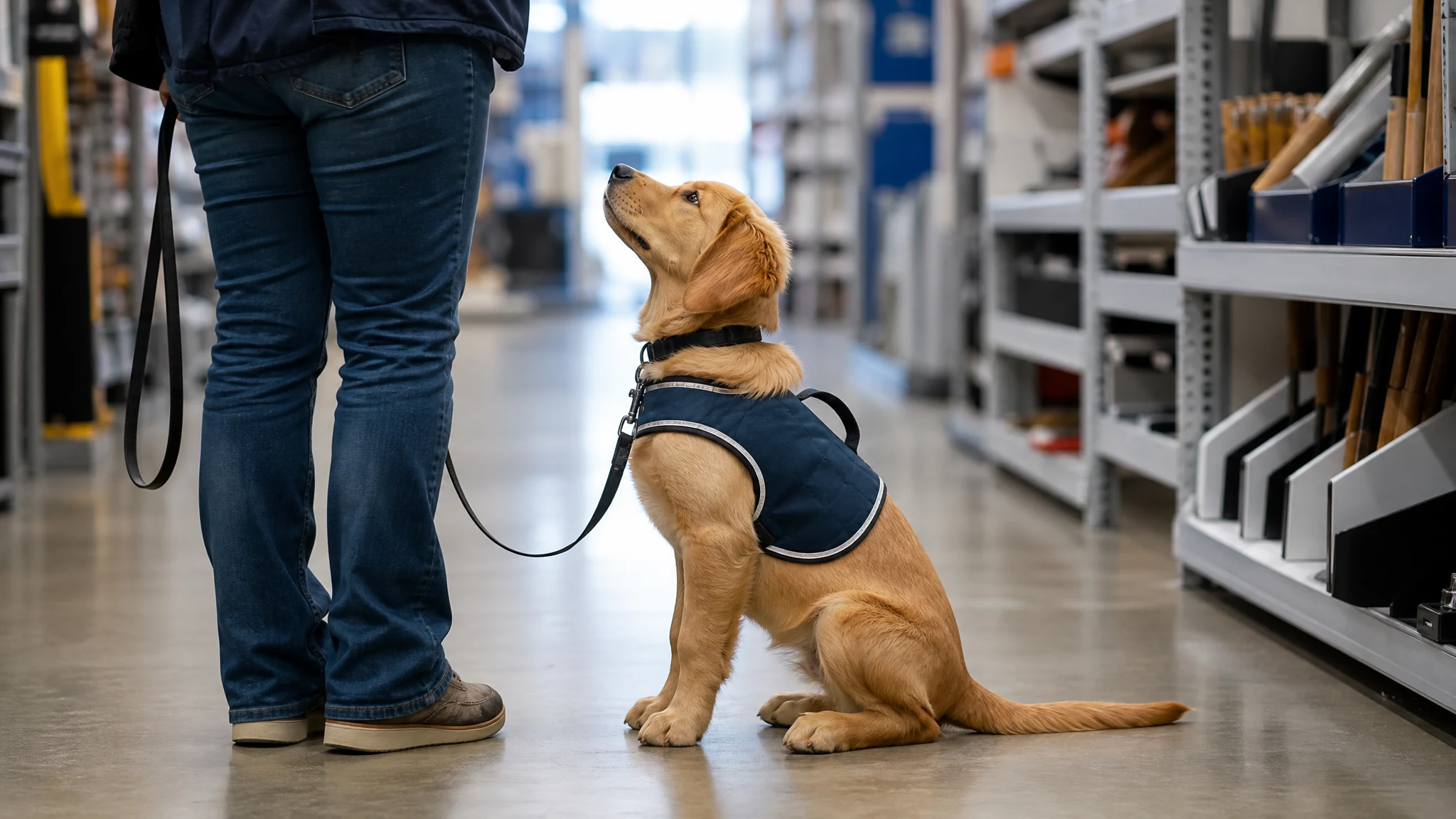
Start where the setting is calm and the risk is low. Think of a quiet outdoor walkway, a hardware store at a slow hour, or a pet-friendly shop. Build up from there. Short, successful visits teach more than long, stressful ones.
Step 4: Ask before you go, especially in places where food is handled
Because Wyoming's statute is silent on several conditions, a quick call to the manager is the safest habit. Say who you are, what the dog is, and what you plan to practice. Ask whether they are comfortable with it. A yes from the manager settles the question for that visit. A no means you thank them and go elsewhere.
Asking permission also builds goodwill. Businesses that have a good experience with a training team are more likely to welcome the next one.
Step 5: Practice the skills that matter in public
Work on one skill per outing and reward often. Useful basics include:
- Walking on a loose leash past distractions.
- Settling under a table or beside a chair.
- Ignoring dropped food and other dogs.
- Waiting calmly at doors and in lines.
Use rewards, praise and good timing. The American Veterinary Society of Animal Behavior (AVSAB) supports reward-based training. Do not use shock, prong or choke collars, alpha rolls, scruffing or dominance methods. They can harm the dog and damage the trust a service dog needs.
Step 6: Handle questions and pushback calmly
If staff ask about your dog, be honest and brief. Under ADA.gov's guidance, when the need is not obvious, staff may ask whether the dog is a service animal required because of a disability and what work or task it has been trained to perform. Those questions are written for trained service dogs. If your dog is still in training, say so plainly. Do not claim it is a fully trained service dog to get past the door.
If a business says no, leave politely. Arguing in the entrance rarely helps you or your dog, and you can follow up later by contacting the right agency.
Step 7: Keep a simple log
After each outing, note the location, how long you stayed, what the dog did well, and what needs work. If you are ever turned away, write down the date, the place and what was said. A record helps if you decide to raise a concern later.
Housing and work are separate questions
Public access is only one area. Housing follows different rules. Under W.S. 35-13-201(c), as summarized by the Animal Legal and Historical Center, a person with an assistance animal may not be discriminated against in leasing or renting residential property, the animal must be permitted, and the person is liable for damage the animal causes. Wyoming's "assistance animal" definition in 35-13-205 is broader than the ADA's, and per that summary it includes animals such as emotional support animals. The federal Fair Housing Act also applies.
For work, the Wyoming Fair Employment Practices Act, W.S. 27-9-105, bars employers from discriminating because of disability, among other grounds. As summarized by Teambridge, it does not say anything specific about service animals. Ask the agency below before assuming how it applies to a dog.
Tips and common mistakes
- Do not buy a vest, ID or certificate as "proof." Nothing in the ADA or the Wyoming text reviewed requires one, and none is legal proof of status.
- Do not assume the ADA protects a dog in training. Its definition describes a trained dog. Rely on the Wyoming statute and on permission.
- Do not state conditions the law does not state. Telling a manager that "the law requires" a certain age or gear when the text does not say so can hurt your credibility.
- Do not push a dog past its limit. A fearful or overexcited dog needs a quieter setting, not more pressure.
- Do not skip the call. Asking first takes two minutes and avoids most conflicts.
- Do not misrepresent your dog. Wyoming treats knowing and intentional misrepresentation as a misdemeanor with a fine of up to $750.
If you are turned away or treated unfairly
No official Wyoming state agency page was found that takes complaints about service animal access in places of public accommodation. For a general discrimination concern, the Wyoming Department of Workforce Services Equal Opportunity Officer is at 5221 Yellowstone Road, Cheyenne, WY 82009, phone (307) 777-7807. For employment discrimination, the department's Wyoming Fair Employment Program in Labor Standards handles complaints. For federal rules and complaint options on trained service dogs, start at ADA.gov.
Because the public access picture for dogs in training depends on how the statute is read, consider asking an attorney or a disability rights organization if you face a serious dispute.
Expected results
Following these steps may help you train in public with fewer conflicts. Many handlers find that asking permission, starting with easy settings and keeping visits short helps both dog and handler build confidence. Results vary with the dog, the handler, the setting and how consistent the training is, and nothing here can promise how any business will respond.
What you can count on is a clearer understanding of the law: Wyoming's definition of service animal includes a dog being trained, the statute text reviewed does not say who qualifies or what gear or age conditions apply, and no registry or certificate is required or recognized as proof.
Wyoming programs to ask about training
If you are looking for guidance on training itself, a few Wyoming organizations are listed below. Ask each directly about cost, waitlists and eligibility, since those details are not confirmed here.
- K9s 4 Mobility, Inc in Cheyenne, an Assistance Dogs International member. It states that it does not train dogs for PTSD, hearing loss or alerting to medical emergencies.
- Project Kenny, which places service dogs with veterans and service members at no cost to the recipient, with an in-person handoff and training in Casper. Its site says the waitlist is typically one to two years.
- Dogs and Tags of Wyoming in Cheyenne, which trains dogs for people with PTSD, TBI and mobility needs. Contact them about fees, since its own site does not list a price.
Sources
- Animal Legal and Historical Center, Michigan State University: Wyoming Consolidated Assistance Animal/Guide Dog Laws (W.S. 35-13-201 to 35-13-205)
- ADA.gov: Service Animals FAQs
- Wyoming Department of Workforce Services: Equal Opportunity
- Wyoming Department of Workforce Services: Labor Standards, Workers and Job Seekers
- Teambridge: Wyoming Anti-Discrimination summary (W.S. 27-9-105)